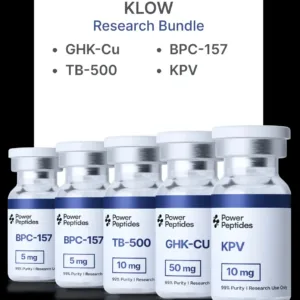
BPC + TB4 combo
Characteristics
| Molecular Formula | C62H98N16O22 (BPC-157), C212H350N56O78S (TB-500) |
| CASNumber | 137525-51-0 (BPC-157), 77591-33-4 (TB-500) |
| Molar Mass | 1419.56 g/mol (BPC-157), 4963.49 g/mol (TB-500) |
| Amino Acid Sequence | BPC-157: Gly-Glu-Pro-Pro-Pro-Gly-Lys-Pro-Ala-Asp-Asp-Ala-Gly-Leu-Val, TB-500: Ser-Asp-Lys-Pro-Asp-Met-Ala-Glu-Ile-Glu-Lys-Phe-Asp-Lys-Ser-Lys-Leu-Lys-Lys-Thr-Glu-Thr-Gln-Glu-Lys-Asn-Pro-Leu-Pro-Ser-Lys-Glu-Thr-Ile-Glu-Gln-Glu-Lys-Gln-Ala-Gly-Glu-Ser |
| Synonyms | Body Protection Compound-157, Thymosin beta-4 |
| Solubility | Water-soluble |
| Organoleptic Profile | White lyophilized powder |
| Composition | Blend of BPC-157 and TB-500 peptides |
| Form | Lyophilized powder |
| Storage | Store at -20 °C, dry and protected from light. Short-term storage at 2-8 °C is acceptable for up to 4 weeks. |
How does BPC-157 and TB-500 blend work?
BPC-157 and TB-500 each have unique mechanisms of action. BPC-157 has been shown to promote angiogenesis, stimulate collagen synthesis, and modulate the nitric oxide (NO) system, which plays a crucial role in wound repair and tissue remodeling. Additionally, BPC-157 exhibits anti-inflammatory properties by modulating the activity of inflammatory mediators such as cytokines and free radicals.
TB-500, on the other hand, is involved in the regulation of actin polymerization, a process essential for cell migration and tissue repair. It has also been studied for its effects on keratinocyte and endothelial cell migration in wound-repair and angiogenesis models. Furthermore, TB-500 has been shown to downregulate inflammatory cytokines, contributing to its anti-inflammatory effects.
In combination, BPC-157 and TB-500 have been studied together in tissue-repair models. Endpoints examined include the formation of new blood vessels, collagen synthesis, inflammation, and the migration and differentiation of cells involved in tissue repair.
Handling & Safety
Handle as a laboratory research chemical of unknown hazard. Use gloves and eye protection, avoid inhalation of the lyophilized powder, and follow standard laboratory handling procedures.
Reconstitute and store according to the product label. Lyophilized material should be kept cool, dry and protected from light; reconstituted material should be held at 2-8°C and protected from light.
The safety profile of BPC + TB4 combo has not been established. This compound is supplied for laboratory research use only and is not approved for human or veterinary use.
Summary
The BPC-157 and TB-500 blend is a combination of peptides studied by researchers investigating wound repair and tissue remodeling. Studies of these peptides have examined angiogenesis, collagen synthesis, cell migration, and anti-inflammatory properties. As a versatile tool for researchers, the BPC-157 and TB-500 blend remains a subject of laboratory investigation.
Resource
Supplied by Power Peptides within the Peptide Blends & Bundles category alongside related reference materials including BPC-157, GHK-Cu, and PT-141. All products on this site are intended for research and development purposes only and are not meant for human consumption of any kind. The statements made within this website have not been evaluated by the U.S. Food and Drug Administration (FDA). Neither the statements nor the products offered by this company are intended to diagnose, treat, cure, or prevent any disease.